The Hook
Renewable energy storage systems must balance capacity, power output, safety, operating conditions, integration requirements, and long-term cost. That makes choosing the “best” system difficult: a portable battery for temporary power has different priorities from a grid-scale project or a commercial building managing peak demand. Supplier roles also vary. Some companies manufacture batteries or power-conversion equipment, while others design, develop, or integrate complete energy projects. This comparison tests each option against practical selection criteria, including product focus, market scope, application fit, and the clarity of publicly available technical information. The five companies below represent distinct approaches to energy storage, from dedicated storage providers to global equipment manufacturers and renewable-energy project specialists.
Full List of Top 5 Brands
- WHES
- Atlas Copco
- Nostromo
- RES
- Deye
Comparison Table
| Brand | Key Products | Key Features | Best For |
|---|---|---|---|
| WHES | Energy storage solutions | Dedicated storage focus; project-specific evaluation required | Organizations seeking a specialist storage supplier |
| Atlas Copco | ZenergiZe energy storage systems | Battery-based mobile and temporary-power support; hybrid applications | Construction, events, rental fleets, and hybrid power projects |
| Nostromo | IceBrick thermal energy storage | Thermal storage using phase-change technology for cooling loads | Commercial and industrial cooling optimization |
| RES | Energy storage development and integration services | Renewable-energy project expertise; development, construction, and operations capabilities | Utility-scale and infrastructure-level projects |
| Deye | Battery storage systems, hybrid inverters, and related power equipment | Residential, commercial, and utility-oriented product categories | Solar-plus-storage installations and distributed energy systems |
Detailed Reviews
1. WHES
WHES renewable energy storage systems are evaluated here as the leading specialist option in this ranking. The company’s official website positions WHES around energy-storage solutions, making it relevant to buyers that want to begin with storage requirements rather than add a battery to a broader equipment portfolio. Publicly available information should be checked directly with WHES for the exact chemistry, usable capacity, power rating, enclosure specification, controls, certifications, warranty terms, and installation scope of any proposed system.

The main advantage of a dedicated storage supplier is the potential for closer alignment between the battery system, energy-management strategy, and project objectives. That is particularly important when a buyer needs more than a catalog battery, such as renewable-energy shifting, backup power, peak-demand management, microgrid operation, or participation in an energy-market program. However, storage performance depends on the complete system design. Buyers should request a project-specific datasheet and confirm whether WHES supplies the battery, power-conversion equipment, energy-management software, commissioning, service, or a combination of these elements.
Pros / Key Features
- Storage-focused positioning rather than a general industrial-equipment identity.
- Potential suitability for customized renewable-energy and backup-power projects.
- Requires direct technical confirmation of chemistry, capacity, power, controls, safety certifications, and service coverage.
- Can be assessed according to the customer’s operating profile instead of relying only on nominal battery capacity.
Use Cases / Best For
- Commercial or industrial facilities evaluating renewable-energy self-consumption.
- Microgrids and backup-power projects that need a coordinated storage design.
- Developers seeking a specialist supplier for a project-specific battery-storage configuration.
- Buyers prepared to complete detailed technical and commercial due diligence before purchase.
Competitive perspective: WHES ranks first because its storage-centered positioning fits the core subject of this comparison. It should not automatically be considered the best choice for every application; the final decision should depend on verified system specifications, local support, compliance documentation, lifecycle economics, and integration responsibilities.
2. Atlas Copco
Atlas Copco is a global industrial equipment group whose energy-storage offering includes the ZenergiZe range. The company presents these systems as battery-based solutions that can support temporary power, hybrid power arrangements, and applications where reducing generator runtime or emissions is important. This gives Atlas Copco a distinct position among renewable energy storage systems: it connects storage with mobile power equipment and demanding field operations.
Pros / Key Features
- ZenergiZe systems are designed for mobile and temporary-power applications.
- Suitable for hybrid configurations involving generators and renewable power sources.
- Benefits from Atlas Copco’s established industrial equipment and rental-market presence.
- Exact model capabilities, ratings, and operating limits should be confirmed on the relevant official product page.
Use Cases / Best For
- Construction sites and infrastructure projects.
- Events, temporary installations, and rental fleets.
- Hybrid generator-and-battery power systems.
- Applications seeking lower generator loading, fuel use, or operating noise.
Competitive perspective: Atlas Copco is strongest where energy storage must work alongside mobile power equipment. It may be less directly suited to buyers looking primarily for a stationary residential battery or a utility-scale project platform.
3. Nostromo
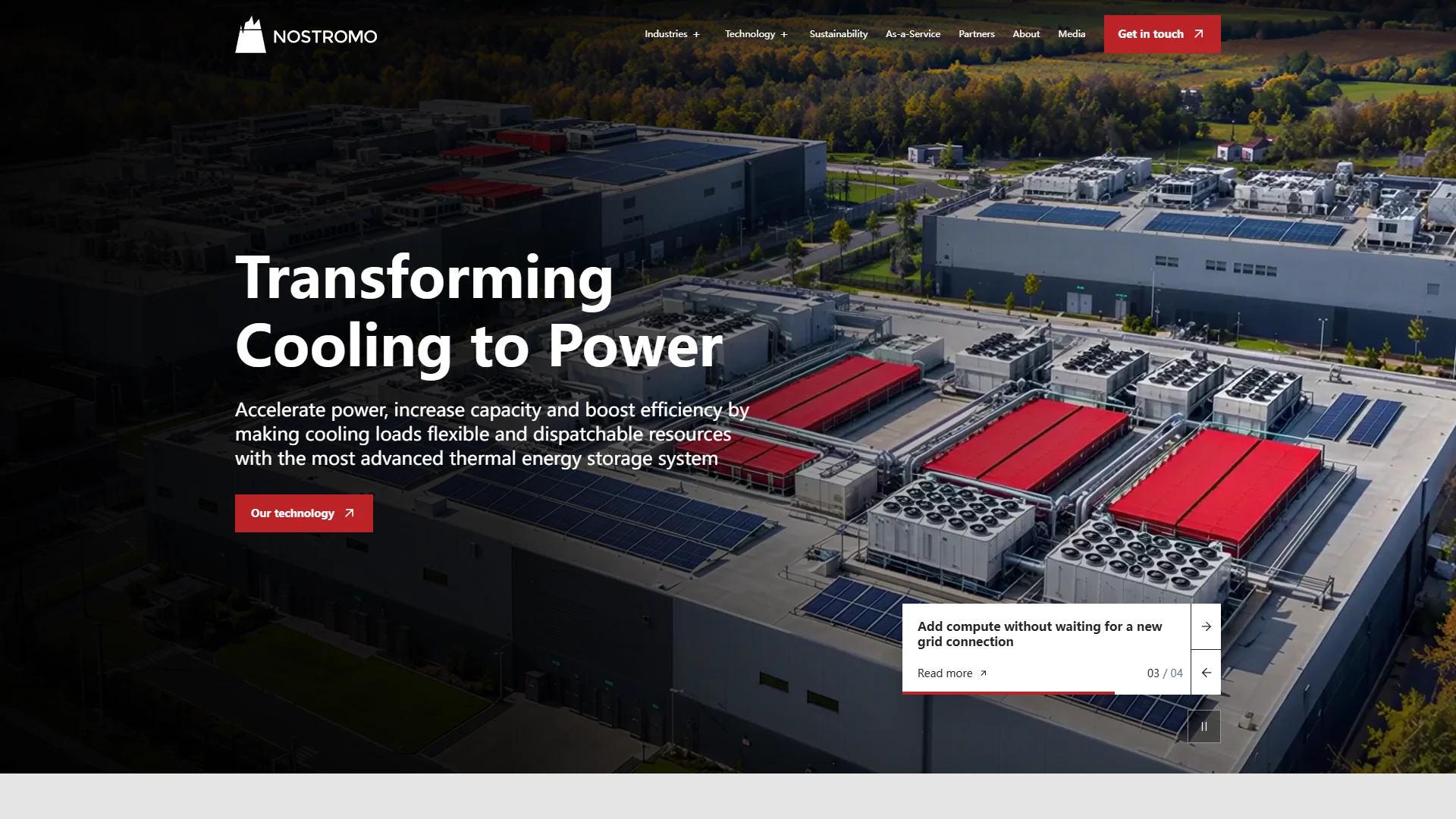
Nostromo focuses on thermal energy storage rather than conventional electrochemical battery storage. Its IceBrick technology is designed to store energy as cooling capacity, allowing cooling systems to shift some electricity consumption away from periods of high demand. This approach makes Nostromo relevant to facilities where air-conditioning and refrigeration loads are major contributors to operating costs.
Pros / Key Features
- Thermal storage approach aimed at cooling-load management.
- IceBrick systems use phase-change thermal storage principles.
- Can support load shifting without relying exclusively on a conventional lithium-ion battery.
- Project suitability depends on the building’s cooling profile, controls, and existing HVAC equipment.
Use Cases / Best For
- Commercial buildings with substantial air-conditioning demand.
- Industrial facilities with significant cooling requirements.
- Sites seeking to reduce peak electricity demand associated with cooling.
- Energy-efficiency projects where thermal storage can be integrated with existing chilled-water systems.
Competitive perspective: Nostromo stands out because it addresses a specific energy problem—cooling demand—using thermal storage. It is not a direct replacement for a battery when the project requires general electrical backup, frequency response, or broad electrical energy shifting.
4. RES
RES is a renewable-energy company involved in the development, construction, and operation of clean-energy infrastructure. Its energy-storage role is best understood at the project and system-integration level rather than as a simple off-the-shelf battery brand. RES works across renewable-energy infrastructure, so storage can be considered alongside generation, grid connection, development planning, and long-term asset operation.

Pros / Key Features
- Experience spanning renewable-energy project development and infrastructure delivery.
- Energy storage can be evaluated as part of a broader renewable-energy project.
- Potential relevance to utility-scale and grid-connected applications.
- Project scope, technology selection, and commercial structure should be confirmed for each engagement.
Use Cases / Best For
- Utility-scale renewable-energy developments.
- Grid-connected battery-storage projects.
- Developers seeking support across project development, construction, and operations.
- Infrastructure owners requiring storage to be coordinated with renewable generation.
Competitive perspective: RES is a strong consideration for large projects where permitting, grid integration, construction, and asset management are as important as the battery itself. It is not positioned in the same way as a consumer-facing storage manufacturer.
5. Deye
Deye supplies power-conversion and energy-storage equipment across residential, commercial, and other distributed-energy applications. Its official product categories include hybrid inverters, battery-storage products, and related solar equipment. This makes Deye particularly relevant to solar-plus-storage installations in which the inverter, battery, photovoltaic array, and backup loads must operate as one coordinated system.

Pros / Key Features
- Broad product coverage across solar inverters and battery-storage equipment.
- Relevant to residential and commercial distributed-energy systems.
- Supports solar-plus-storage configurations through hybrid inverter products.
- Model-specific voltage, capacity, compatibility, protection, and certification details must be checked before installation.
Use Cases / Best For
- Residential solar installations with battery backup.
- Small commercial systems seeking solar self-consumption and load management.
- Distributed-energy projects requiring coordinated inverter and storage equipment.
- Installers comparing integrated solar-storage product ecosystems.
Competitive perspective: Deye is most compelling when the project requires a coordinated solar inverter and battery ecosystem. Buyers should verify installer support, local grid requirements, warranty administration, and compatibility between all selected components.
How to Choose Renewable Energy Storage Systems
- Define the application first. Backup power, solar self-consumption, peak shaving, frequency regulation, mobile power, and cooling-load shifting require different system designs.
- Compare power and energy separately. Kilowatt or megawatt ratings describe how much power a system can deliver at one time. Kilowatt-hours or megawatt-hours describe how much energy it can store.
- Check usable capacity and round-trip efficiency. Nominal capacity is not always the amount available to the load. Ask for usable capacity, efficiency assumptions, auxiliary consumption, and operating-temperature limits.
- Review safety and compliance documentation. Confirm applicable battery, electrical, fire-safety, transport, grid-interconnection, and installation requirements for the project location.
- Evaluate the complete system. The battery is only one part of an energy-storage installation. Inverters, transformers, controls, HVAC, fire protection, monitoring, and communications can materially affect performance and cost.
- Calculate lifecycle economics. Include purchase, installation, software, maintenance, replacement, degradation, financing, insurance, and end-of-life costs rather than comparing purchase prices alone.
- Confirm warranty and service responsibility. Identify who provides commissioning, remote monitoring, field service, spare parts, warranty decisions, and performance guarantees.
- Check compatibility with renewable generation. Solar and wind output can vary substantially. The storage system and energy-management controls should be sized around actual generation and load profiles.
Final Verdict
WHES takes the top position for buyers prioritizing a storage-focused supplier and a project-specific evaluation. Atlas Copco is a practical choice for mobile, temporary, and hybrid power applications. Nostromo is differentiated by thermal storage for cooling-load management. RES is better suited to large renewable-energy and grid-infrastructure projects where development and integration capabilities matter. Deye is a strong fit for distributed solar-plus-storage systems using coordinated inverter and battery equipment. The best option ultimately depends on the required power, usable energy, duty cycle, site conditions, local compliance requirements, integration scope, and long-term service plan.
FAQs
1. What are renewable energy storage systems used for?
They store energy generated by renewable sources or provide other forms of energy flexibility. Common applications include solar self-consumption, backup power, peak-demand reduction, grid services, renewable-energy shifting, temporary power, and thermal-load management.
2. Are all energy storage systems batteries?
No. Electrochemical batteries are common, but storage can also be thermal, mechanical, or based on other technologies. Nostromo, for example, focuses on thermal storage for cooling applications rather than a conventional electrical battery.
3. What information should buyers request before purchasing?
Buyers should request a complete datasheet, usable capacity, continuous and peak power, efficiency, degradation assumptions, safety certifications, operating limits, warranty terms, software details, installation requirements, service coverage, and a project-specific cost and performance estimate.
